Medical Card
Get Your Medical Marijuana Card Today
Meet with a healthcare provider in minutes and receive the best care for the best value.
Get your medical card online in minutes!
Get startedExplore A-Z conditions
Medical Card
Meet with a healthcare provider in minutes and receive the best care for the best value.
Autoimmune diseases occur when the immune system mistakenly attacks the body’s own healthy tissue. The resulting chronic inflammation, pain, and organ damage are the primary targets of both conventional and alternative therapies.
The endocannabinoid system (ECS) is a network of receptors — primarily CB1 and CB2 — distributed throughout the immune system, nervous system, and peripheral tissues. In autoimmune conditions, the ECS is dysregulated, contributing to unchecked inflammation. Phytocannabinoids from cannabis interact with these receptors to help re-regulate immune activity and reduce the release of pro-inflammatory cytokines.
A 2021 review published in Autoimmunity Reviews concluded that both CB1 and CB2 receptors are “promising targets for managing autoimmune diseases,” noting that cannabinoids can suppress inflammatory cytokines, inhibit T cell proliferation, and modulate myeloid-derived suppressor cells (MDSCs).[1]
Cannabidiol (CBD) is non-psychoactive and acts primarily through CB2 receptors and several non-cannabinoid pathways. It has been shown to:
Tetrahydrocannabinol (THC) is psychoactive and binds to both CB1 and CB2 receptors with relatively high affinity. In autoimmune contexts, it:
Whole-plant cannabis formulations may offer additional benefit through the ‘entourage effect’ — the synergistic interaction of cannabinoids, terpenes, and flavonoids. The most relevant compounds for autoimmune conditions include:
| Compound | Potential role in autoimmune disease |
|---|---|
| Beta-caryophyllene (terpene) | CB2 receptor agonist — directly reduces inflammatory cytokine release |
| CBG (cannabigerol) | May suppress immune function and protect against autoimmune encephalomyelitis |
| CBN (cannabinol) | Sedative and anti-inflammatory; may support sleep during flare-ups |
| THCA (raw THC acid) | Anti-inflammatory without psychoactivity; found in raw/juiced cannabis |
| Myrcene (terpene) | Sedative, analgesic; synergises with THC for pain and muscle spasms |
| Flavonoids (cannflavins, quercetin) | Anti-inflammatory; being studied as sources of new autoimmune drugs |
There is no single ‘best’ product for autoimmune disease — the right approach depends on your specific condition, symptoms, tolerance, and whether psychoactive effects are acceptable to you. That said, some general guidance applies across most autoimmune conditions:
If you prefer no psychoactive effects
Start with a high-CBD, low-THC product (CBD:THC ratio of 10:1 or higher). Look for products containing CBD alongside beta-caryophyllene and myrcene terpenes for additional anti-inflammatory benefit. These are appropriate for daytime use and for people who are new to cannabis or concerned about workplace or safety implications.
If pain or spasticity is a primary concern
A balanced 1:1 CBD:THC product may provide more complete symptom relief, particularly for musculoskeletal pain, joint stiffness, and muscle spasms. The psychoactive effect of THC is mitigated when combined with CBD. Start with a low dose and use in the evening until you know how it affects you.
For flare-ups and sleep disruption
A higher-THC product with sedative terpenes (myrcene, linalool) may be appropriate at night for managing acute flares, insomnia, and severe pain. This should be discussed with a medical cannabis physician, particularly if you are on immunosuppressants or other medications.
The method of consumption significantly affects onset time, duration, and which tissues receive the most benefit:
| Method | Onset / Duration / Notes |
|---|---|
| Sublingual (oil/tincture) | 15–45 min onset · 4–6 hrs · Good for consistent dosing; flexible CBD:THC ratios |
| Oral (capsules, edibles) | 30–90 min onset · 6–8 hrs · Higher bioavailability in intestinal lymphatic tissue — may be especially beneficial for IBD and gut-related autoimmune conditions |
| Vaporised flower/concentrate | 1–5 min onset · 2–3 hrs · Fastest relief for acute flares or spasms; not recommended for those with lung conditions |
| Topical (cream, balm) | 15–30 min local onset · No systemic effects · Suitable for localised joint or skin inflammation (RA, psoriasis, lupus rash) |
Note: Research suggests that oral cannabis reaches higher concentrations in intestinal lymphatic tissue than in the central compartment,[4] making it potentially advantageous for Crohn’s disease, ulcerative colitis, and other gut-affecting autoimmune conditions.
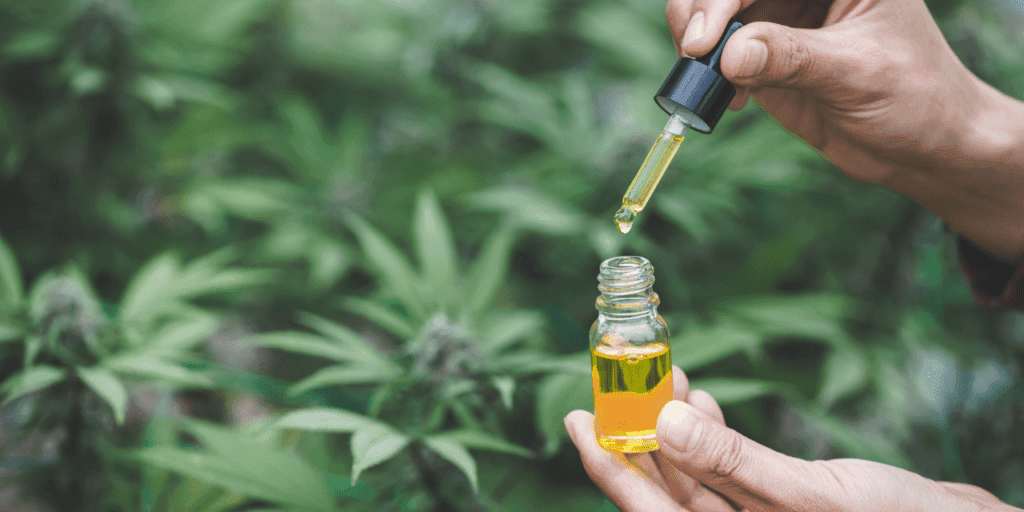
There is no standardised dose for autoimmune conditions. General clinical practice recommends:
⚠ Important: drug interactions
Cannabis, particularly CBD, is metabolised by the cytochrome P450 liver enzyme system and can affect the blood levels of several medications commonly prescribed for autoimmune diseases — including warfarin, cyclosporine, tacrolimus, and methotrexate. Always disclose cannabis use to your physician and pharmacist before starting.
Yes — many autoimmune conditions qualify for a medical marijuana card in states with medical cannabis programs. Eligibility is determined state by state, but several autoimmune conditions appear across most qualifying condition lists:
| Autoimmune condition | Commonly approved in state MMJ programs? |
|---|---|
| Rheumatoid arthritis (RA) | Yes — typically listed under ‘chronic pain’ or ‘inflammatory conditions’ |
| Multiple sclerosis (MS) | Yes — widely listed; often includes spasticity as a qualifying symptom |
| Crohn’s disease / ulcerative colitis (IBD) | Yes — listed explicitly in most states with medical programs |
| Lupus (SLE) | Yes in several states; often approved under ‘chronic inflammatory conditions’ |
| Psoriasis / psoriatic arthritis | Varies; more commonly approved via ‘chronic pain’ qualification |
| Type 1 diabetes | Less common but possible; depends on associated neuropathy or pain |
| Hashimoto’s / hypothyroidism | Rarely listed directly; may qualify via associated fatigue or pain |
The qualifying condition list differs by state. Leafwell’s licensed physicians can evaluate your specific autoimmune condition and confirm whether you qualify in your state — typically in a same-day telehealth appointment.
Cannabis may help manage the symptoms of autoimmune diseases — including chronic pain, inflammation, fatigue, and sleep disturbance — through the anti-inflammatory and immunomodulatory properties of its cannabinoids. Both THC and CBD interact with the body’s endocannabinoid system (ECS), which plays a central role in regulating immune responses. While cannabis cannot cure autoimmune conditions, clinical and preclinical evidence suggests it can meaningfully reduce the immune overactivation and pain that drive these diseases’ most debilitating symptoms.
Autoimmune diseases occur when the immune system loses the ability to distinguish the body’s own healthy cells from foreign invaders, and begins attacking its own tissues. Around 50 million Americans live with an autoimmune condition, making it the third most prevalent disease category in the US. Women account for 75–80% of cases, partly due to differences in immune system activity.
Some autoimmune diseases target a single organ — for example, Hashimoto’s thyroiditis attacks the thyroid. Others are systemic, affecting multiple organ systems, as in lupus, which can involve joints, skin, kidneys, the brain, and blood cells.
Symptoms vary by condition but commonly include:
Other notable autoimmune conditions include lupus (SLE), multiple sclerosis (MS), psoriasis, Sjögren’s syndrome, Crohn’s disease, and systemic sclerosis / scleroderma. Having one autoimmune condition significantly raises the risk of developing another.
The root cause of autoimmune disease is not fully understood, but is thought to involve a combination of genetic predisposition and environmental triggers. Common triggers include:
Standard medical treatments for autoimmune disease aim to suppress the overactive immune response and manage symptoms:
Cannabis is typically considered an adjunctive therapy — used alongside, not instead of, conventional treatment. Some patients are able to reduce their NSAID or opioid use with medical cannabis, but this should always be managed by a physician.
Select your state from the drop down and we’ll let you know.